

BA (Hons) Creative Writing and Film Studies
- Entry year:
- 2026/27
- Start date:
- September
- Study mode:
- Full-time
- Course duration:
- 3 years
- Campus:
- Mount Pleasant
- UCAS Code:
- WW86
Why study this course with LJMU?
- Gain a holistic view of film and filmmaking, including scriptwriting, digital film production, film history and theory
- Professional guidance and peer support to help you develop your writing, production and critical skills
- Teaching is based in the Mount Pleasant Campus and film production facilities are located in the Redmonds Building, both close to Liverpool City Centre
- Liverpool has more theatres, cinemas, literary events, arts centres, galleries and museums than any city outside London
- LJMU ranked 7th university in the UK for Creative Writing (The Times UK University Rankings 2025)
- 96% of students surveyed said the teaching staff on our creative writing courses were good at explaining things (National Student Survey 2025)
About your course
As a student on the BA (Hons) Creative Writing and Film Studies at Liverpool John Moores University you will be taught by internationally published poets, novelists and film industry professionals.
The degree combines practice in screenwriting, digital film production, and other writing forms with a critical study of film and written texts. As the degree progresses, you will be able to specialise in screenwriting and produce your own scripts for short films (fiction and documentary) and longer dramas, as well as learning to write treatments and pitch your ideas to a professional standard.
This hybrid degree combines practical and theoretical work which allows students to pursue their own interests. You will explore the development of cinema worldwide, while providing you with extensive hands-on filmmaking and editing experience using our industry-standard facilities including a production studio, a green screen, digital cameras and designated editing suites. You’ll have the opportunity to create an impressive portfolio of your own. Liverpool is the second most filmed city in the UK after London and the perfect place to start your screenwriting and filmmaking career.
We receive regular visits from guests who are renowned in their fields, with recent talks from the likes of Andrea Gibb, Lizzie Nunnery, Stewart Harcourt, Jayshree Patel, Torfinnur Jakupsson, Phil Collinson and Russell T Davies.
You will have plenty of opportunities to hone your writing and production techniques. As you move through the three years of your degree programme, you’ll acquire a holistic understanding and knowledge of film. Towards the end of your studies, you will be expected to produce near-professional standard scripts and short films.
In addition to formally taught courses, there are opportunities for work-based learning, visits and trips, as well as encouraging independent research in almost any area of Creative Writing and Film Studies and in your final year you will be able to undertake an option in freelance writing and/or production.
Watch our 2022 Creative Writing showcase

Find out more about studying BA (Hons) Creative Writing

Course modules
What you will study on this degree
Further guidance on modules
Modules are designated core or optional in accordance with professional body requirements, as applicable, and LJMU’s Academic Framework Regulations. Whilst you are required to study core modules, optional modules provide you with an element of choice. Their availability may vary and will be subject to meeting minimum student numbers.
Where changes to modules are necessary these will be communicated as appropriate.
Core modules
Production Skills
20 credits
20 credits
Through a series of lectures and practical workshops students will be introduced to fundamental film production skills using cameras, lenses, lighting and sound equipment. Students will develop an understanding of how historical developments in film craft inform current film productions and explore current trends and best practice in digital filmmaking.
Observation and Discovery
20 credits
20 credits
The module encompasses intercultural and boundary spanning skills, professional written and spoken communication and collaboration between students as they are introduced to workshopping techniques.
Language and Craft
20 credits
20 credits
As with other Level 4 modules, this module is designed to encourage consistent engagement, with smaller assessment items that build on each other in terms of attention to language and form, providing both summative and formative feedback. This module aims to develop student skills in textual analysis and academic writing skills.
Film Language
20 credits
20 credits
In studying film language students will gain key foundational skills in practising in textual analysis in relation to film.
Film Theory
20 credits
20 credits
This course surveys the history of the various traditions of theoretical inquiry in film studies. We investigate textual criticism (formalism, structuralism and auteur theory), identity politics, (feminism, masculinity, queer and disability theory and race) and various other theoretical paradigms.
Character and Story
20 credits
20 credits
The module explores the building blocks of character development and character driven story lines through various forms of writing and requires the student to evidence a variety of research skills and evidence professional written and communication skills, and collaboration between students as they are introduced to workshopping techniques.
Optional modules
Experimental Filmmaking
20 credits
20 credits
In this module you will have the opportunity to gain hands-on experience, planning and managing a short experimental film production. You will be able to develop specific skills in the areas of cinematography, lighting and sound design, as well as post production skills in editing and colour grading that are appropriate for experimental filmmaking.
American Cinema
20 credits
20 credits
Through a series of seminars student will develop a deep understanding of developments in American cinema from its beginnings to the present day. Students learn about early entrepreneurial approaches to cinema, through to the studio system, independent production, post-studio conglomerations, censorship, and international co-production.
Film Adaptation
20 credits
20 credits
This module will consider theoretical debates such as the limitations of Fidelity and whether Adaptation can be considered a genre. Specific attention will be paid to Stage to Screen adaptations, Shakespearian translations, Comic book and Video Game adaptations and Fan Adaptations. The module also includes a series of workshops and tutorials designed to develop student screenwriting skills as they create an adapted screenplay.
Study Semester Abroad - Creative Writing and Film Studies
60 credits
60 credits
The aim is to provide students with a semester of study at an approved overseas partner that will replace one semester of their LJMU programme at level 5. This is a semester of full-time study at an approved higher education institution which will replace one semester of level 5 study at LJMU. The modules to be studied must be agreed in advance, and must be an appropriate substitute for the modules being replaced. Assuming successful completion of this semester, mark-bearing credit will be awarded by the University Recognition Group. The grade conversion scale to be used will be made available in advance of the semester abroad.
Study Year Abroad -Creative Writing and Film Studies
120 credits
120 credits
Video Essay
20 credits
20 credits
Through a series of lectures and practical making workshops, students will be introduced to the video essay as a form of scholarly engagement with Film. They will gain familiarity with current practice within the academic video essay community and explore existing scholarship on the developing form of the scholarly video essay as a legitimate form of academic research and publication.
Documentary Filmmaking
20 credits
20 credits
This module will introduce you to the basic principles of directing, filming, editing and producing for a short documentary film.
Fiction Filmmaking
20 credits
20 credits
The fiction filmmaking module will develop students’ knowledge and experience of the technical, creative, organisational and administrative demands involved in a short film production. The overarching theme of this module is the development of the creative processes in relation to film production. The short film genre gives students the opportunity to test out ideas or tell a story within the confines of a limited run-time. The relationships between technical, creative, and aesthetic choices will be considered in relation to the ‘real-world’ issues of production management. Working to a brief is designed to give students opportunities for work-based learning.
European Cinema
20 credits
20 credits
This module serves as an introduction to the range and variety of films produced in Europe, as well as to the significance of film festivals for its visibility and promotion. It highlights the diversity of cinematic production in Europe, focusing not only on different national traditions, but also on the fact that European cinemas consist both of art and popular films.
Working in Film
20 credits
20 credits
This module aims to give students an understanding of the working practices and organisation of the British film industry. This module will provide all students with a work-based learning experience through opportunities to network with and present to industry. Students will be encouraged to develop their understanding of the different sectors of the local and national film industry into a recognition of the job opportunities that are presented in an area of personal career interest to them. Students will test out the industry relevance of their careers knowledge by presenting to, and networking with, industry partners. They will then apply to relevant work experience opportunities as part of their career portfolio.
Script Development
20 credits
20 credits
Students will workshop their writing in tutor-led and peer-led sessions, offering and receiving constructive criticism, reading and performing key scenes from their scripts and re-drafting and developing their work. They will also share insights into their ongoing research process with peers. Industry guest speakers will also share their knowledge and experience in seminars and masterclasses.
Short Fiction
20 credits
20 credits
This module expands students' understanding of short fiction and fosters independent reading. It supports their short story writing skills, enhancing their creative confidence and critical insights. Students learn to think creatively about the possibilities of short story writing and develop their ability to evaluate both published authors and peers constructively. Through workshops and essays, students gain a strong foundation in narrative craft, preparing them for more advanced prose modules at Level 6.
Poetry
20 credits
20 credits
This module has creativity embedded throughout, with a heightened awareness of written and spoken communication and the power of language. Poems are designed to be heard as well as read. Students will be reading their own draft poetry aloud in class, thus developing self-confidence in their own voices and work.
Creative Non-fiction
20 credits
20 credits
The module will include a diverse range of texts that promote intercultural understanding. Boundary spanning skills will be developed across the many forms of creative non-fiction and an exploration of the writerly techniques they value.
Screenwriting
20 credits
20 credits
Students will workshop their writing in tutor-led and peer-led sessions, offering and receiving constructive criticism, reading and performing key scenes from their scripts and re-drafting and developing their work. Industry guest speakers will also share their knowledge and experience in seminars and masterclasses.
Writing for Stage & Radio
20 credits
20 credits
In this module, students will learn scriptwriting for radio and stage, focusing on modern techniques. They'll explore these forms through reading and listening, and develop their work collaboratively in a writers' room. Students will also improve their communication skills, refining their scripts through workshops and industry expert input in seminars and masterclasses.
Writing in Production
20 credits
20 credits
The module embeds key employability skills: leadership and motivational skills, analysis and problem-solving, creativity and enterprise, professional written and spoken communication, financial literacy, planning and organisation, digital capability and teamworking and collaboration.
Approaching Your Novel
20 credits
20 credits
In this module, students will learn how to propose novels effectively, understand their target market, and master the art of crafting compelling opening chapters. They'll also explore various novel genres and develop essential narrative skills. Through peer workshops and hands-on practice, students will prepare work suitable for the publishing industry, all while gaining valuable insights into genre, market, and narrative craft.
Optional modules
Black American Film
20 credits
20 credits
The module produces students with a historical overview of Black American identity in film. Topics covered include Minstrelsy, Early Black Pioneers, Stereotyping and Marking, The Emergence of Black Stars, The Civil Rights Era, Blaxploitation, Gangsta Films, Intersectionality and Black Lives Matter.
Film Thesis
20 credits
20 credits
Through a series of lectures and tutorials students will develop their critical thinking and research skills as part of the completion of a large independent study project. They will be encouraged to generate effective strategies to manage their time, meet deadlines, and engage in self-directed study in an area of Film Studies they have a specific interest in.
Advanced Script Workshop 2
20 credits
20 credits
The module is the last step before students either enter the industry or move on to Masters level. In this module, they are encouraged to use the work-shopping skills that they have developed over the previous five semesters to give and receive constructive criticism in peer-led sessions as well as tutor-led work groups. Key employability skills are embedded throughout. These include: analysis, problem-solving and decision-making, communication, ICT, numeracy and financial literacy, planning and organisation and team work and collaboration, as well as creativity and enterprise.
Advanced Prose Workshop 1
20 credits
20 credits
This module is designed to encourage the student to use the technical, cognitive and narrative skills they have acquired to produce a writing portfolio and reflection, using their own strengths and those of the community of writers of which they are a part.
As the workshops are based each week on prepared readings of peer students' draft work, suggestions for wider reading and giving thoughtful and detailed critiques, a student's individual contribution is of great importance. The portfolio may consist of fiction or creative non-fiction. The research portfolio further develops good habits in terms of writing for publication and understanding the market.
Writer at Work: Project
20 credits
20 credits
This module builds on key employability skills providing a work-based learning opportunity whilst also continuing to develop students' skills in research and analytical writing suitable for postgraduate study.
Independent Study: Extended Project
20 credits
20 credits
This module allows students to pursue an individually devised creative project in Creative Writing at an advanced level. Students who wish to take this module will apply in writing and their application may be refused. Students on the module submit a proposal to the module leader who then offers their comments, refining the objectives of the study into an agreed form, at which stage the module leader assigns the student a supervising tutor. The module provides the student with an opportunity to pursue a project which is not accommodated elsewhere in the programme.
Developments in Contemporary Writing and Publishing
20 credits
20 credits
This module delves into contemporary literature, covering fiction, non-fiction, and poetry, and explores current debates in the English-speaking publishing world. It emphasises how production circumstances shape contemporary texts and encourages reflection on the writer's role in modern society. Topics include women's history in the era of #Me Too, climate fiction, diversity in publishing, gender identity, freedom of speech, 'cancel culture,' and pandemic writing. Students will engage with works by various authors such as Hallie Rubenhold, Reni Eddo-Lodge, and Akwaeke Emezi.
World Cinema
20 credits
20 credits
The module provides insights into a range of non-US and non-European cinemas, and critical tools for the students to engage with films from different cultural contexts.
Final Film Pre-Production
20 credits
20 credits
This module gives the students an opportunity to develop their understanding of pre-production skills and practice applied to film making. It enables students to develop an ability to understand and reflect constructively on the pre-production process for independent film production.
Final Film Production
20 credits
20 credits
In this module you will have the opportunity to gain hands-on experience of some of the technical equipment required for short video production at an advanced level with either fiction or non-fiction filmmaking.
Interpretation in Film
20 credits
20 credits
Through a series of seminars student will develop a deep understanding how to interpret film through a variety of theoretical approaches. These will include text-based approaches, as well as other understandings, such as paratexts and promotion, taste cultures, audiences, and fandom.
Work Based Learning
20 credits
20 credits
This module provides Film Studies students with the opportunity to widen their direct knowledge of working practices in a film-related field. The module allows students to widen their contacts and to apply the knowledge and skills they have learned on the programme to a work setting. Students negotiate a learning contract with an employer/client and a tutor, and are assessed on their written account of the content and relevance of their work experience/client project to the Film Studies degree.
Advanced Script Workshop 1
20 credits
20 credits
In this module, students are encouraged to advance the work-shopping skills that they have developed over the previous four semesters to give and receive constructive criticism in peer-led sessions as well as tutor-led work groups. Key employability skills are embedded throughout. These include: analysis, problem-solving & decision-making, communication, ICT, numeracy & financial literacy, planning & organisation and team work and collaboration, as well as creativity and enterprise.
Advanced Poetry Workshop 1
20 credits
20 credits
The focus on published collections encourages students to focus on how a poet's'voice' is developed and how individual poems are collated to inform the collection asa whole.
Digital Writing
20 credits
20 credits
This module enables students to develop an understanding of writing for digital platforms and skillsets necessary to produce digital content. Over the semester students will not only discover the creative possibilities of writing for online platforms but also the career opportunities in this field of writing. The module will look at diverse areas of text and writing online, from media characters portrayed in social networking, bloggers, viral campaigns, podcasts, music production and participatory projects to location based storytelling. The module is open to new and emerging possibilities and platforms.
Writer at Work: Portfolio
20 credits
20 credits
The module will be a mix of class and group activities, sessions with guest speakers, and independent research and planning. It will draw on the expertise of the university's Student Futures team, alongside the subject-specific knowledge of the module teaching team, and a range of guest speakers from the creative industries, to deepen students' understanding of potential employment opportunities and to help them map and plan their own routes towards this. Through a series of guided activities, students will be enabled to reflect on their existing skills and experience, identify areas for development, and explore ways of presenting themselves as writers and creative-industry professionals. They will also develop their skills in research, analytical writing and clear written communication, through researching case studies in the creative industries and writing these up in a comparative analytical study.
Your Learning Experience
Excellent facilities and learning resources
We adopt an active blended learning approach, meaning you will experience a combination of face-to-face and online learning during your time at LJMU. This enables you to experience a rich and diverse learning experience and engage fully with your studies. Our approach ensures that you can easily access support from your personal tutor, either by meeting them on-campus or via a video call to suit your needs.
Teaching is delivered via a combination of lectures, seminars, online activities, writing workshops, film screenings and production group work. We make extensive use of our virtual learning environment, Canvas, to provide course information, further reading and peer interaction.
Work-related Learning
You will have opportunities to complete professional work experience in both Level 5 and 6. The Writer at Work module in your final year also gives you a chance to step inside the writers world by pursuing your own project. This could be anything from organising a poetry festival to placing the idea for a novel with a literary agent, or planning the production of a film. Alternatively you can take up a work placement in your chosen field.
Dedicated personal tutor, plus study skills support
From the moment you begin your studies at LJMU, you will be allocated a personal tutor who will provide one-to-one support over the three years of the course. Their role is to give you feedback on how well you are progressing with your studies and encourage you to plan for your educational and career development.
Assessment varies depending on the modules you choose, but will usually include a combination of exams and coursework.
We acknowledge that all students perform differently according to the type of assessment they are given, and so you will be assessed by a combination of coursework, exams and group productions. Coursework includes essays, reviews, individual and group presentations, individual and group critical self-evaluation, logbooks, self-reflective group portfolios, research exercises, individual work-based learning reports and dissertations. Exams may be seen or unseen and may include class tests. Group productions of audio-visual artefacts include photo-storyboards, vox-pops, and factual and fictional video productions.
Your tutors will provide feedback on your assessments within 15 working days of submission and you will receive regular feedback on draft creative work submitted to workshops. We believe that constructive feedback is vital in helping you identify your strengths as well as the areas where you may need to put in more work.
Where you will study
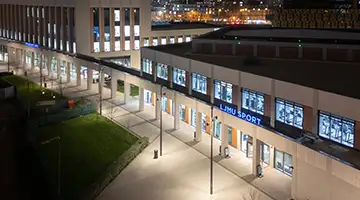
The degree is taught in the Redmonds Building and John Foster Building, situated in the heart of the bustling Mount Pleasant Campus and Liverpool's growing Knowledge Quarter. Redmonds Building is home to high quality lecture theatres and seminar rooms, TV studios, radio suites, green screen, editing rooms and newsrooms, social spaces, and a café. It is only a short walk from LJMUs Mount Pleasant Campus Library, which contains all the resources you will require for your studies, and is open 24 hours a day, seven days a week.
Course tutors

<p>Sarah gained a BA and MA with LJMU, then worked for Property Services and Student Support. She has taught at LJMU since 2006, and is now the Programme Leader in Creative Writing. In 2013, Sarah won an LJMU Amazing Teaching Award. Sarah is a founder member of the Merseyside Literature Partnership, and is a trustee of a small arts organisation that promotes poetry in Merseyside.</p>
The third year Writer at Work module, unique to LJMU, gives you a chance to step inside the writer's world by pursuing your own project, be it organising a poetry festival, placing the idea for a novel with a literary agent, or planning the production of a film.



This degree was the first time I had direct academic support towards becoming a filmmaker. Since graduating, I have received two short film commissions from The UK Film Council and I am currently co-writing a spec feature for North West Vision.
Career paths
Alongside the skills you will gain in writing to publishable standard and film production practice, the course equips you with an understanding of media processes that could be applied to careers in public relations, advertising, corporate communications, cultural journalism, research and the film and television industries.
Many of our graduates have gone on to work in the film and television industries as writers, directors, researchers and actors. Some have become independent filmmakers or work for companies such as the BBC, Channel 4, Envy Postproduction, FACT, Hurricane Pictures, Lime Pictures, Soapbox and Sony. Others have gone on to pursue postgraduate study at MA and PhD level or have become teachers, journalists and editors.
Student Futures - Careers, Employability and Enterprise Service
A wide range of opportunities and support is available to you, within and beyond your course, to ensure our students experience a transformation in their career trajectory. Every undergraduate curriculum includes Future Focus during Level 4, an e-learning resource and workshop designed to help you to develop your talents, passion and purpose.
Every student has access to Careers Zone 24/7, LJMU's suite of online Apps, resources and jobs board via the LJMU Student Futures website.
Tuition fees and funding
- Full-time per year:
- £9,790
Fees
Tuition fees for home students beginning their studies in September 2026 will be £9,790 for the 2026/27 academic year, subject to Parliamentary approval.
In England and Wales, tuition fees for home undergraduate students are set in accordance with the Government’s regulated fee cap. The Government has confirmed that this cap will be £9,790 for 2026/27 and £10,050 for 2027/28, in both cases subject to Parliamentary approval.
The Government has also indicated that from the 2028/29 academic year onwards, the fee cap may be adjusted annually in line with inflation. As a result, tuition fees in future years may increase in line with inflation. We will provide confirmation of any changes as early as possible in advance of each academic year.
The university reserves the right to increase tuition fees in accordance with any changes to the maximum allowable fees set by the UK Parliament.
The fees quoted above cover registration, tuition, supervision, assessment and examinations as well as library membership and student IT support with access to printed, multimedia and digital resources including programme-appropriate software and on campus Wi-Fi.
Financial Support
The University offers a range of scholarships to support students through their studies. You'll find all the information you need on our specialist funding pages, including details of the Student Support Fund and other activities to support with the cost of living.
Additional Costs
In addition to fees, students should also keep in mind the cost of:
- Accommodation
- Travel costs including those for placements, visas and travel for studying abroad and field trips unless paid for by LJMU
- Stationery, IT equipment, professional body membership and graduation gown hire
- Full-time per year:
- £17,750
International Scholarships and payment plans
Liverpool John Moores University is committed to supporting international students by providing a range of scholarships and flexible payment plans to help students manage their tuition fees.
Scholarships
LJMU provides a variety of undergraduate scholarships to support international students. Scholarships are available to self-funded students who have accepted their offer and met all the conditions outlined in their offer letter. Students must also demonstrate that they can cover living costs, travel, and other expenses associated to studying at the university.
All self-funded international students are eligible for an automatic scholarship worth up to £3,000. For more details and to view our full list of scholarships, visit the international scholarship webpages.
Deposit
All students must pay a £5,000 deposit before they can receive their CAS letter.
For more information view our deposit page.
Tuition Fee Payment Plan
After paying their £5,000 deposit, students have the option to pay their fees in full or in three equal instalments minus any internal scholarships and discounts. There are two payment options available for international students. You can either pay your tuition fees in full before enrolment or opt for a payment plan. With the payment plan, you can pay your fees in three instalments after making your £5,000 deposit. The first instalment is due before enrolment.
All payments should be made through Flywire. Full details can be found in the How to Pay Guide.
Entry requirements
Please choose your qualifications below to view requirements
Grades/points required from qualifications: BBC (112)
Work out how many UCAS points your qualifications are worth by visiting the UCAS Tariff Calculator.
Qualification requirements
GCSEs and equivalents
Grade 4 or grade C or above in English Language and Mathematics/ Numeracy.
GCSE Equivalences accepted:
• Key Skills Level 2 in English/Maths
• NVQ Level 2 Functional skills in Maths and English Writing and or Reading
• Skills for Life Level 2 in Numeracy/English
• Higher Diploma in Maths/English
• Northern Ireland Essential Skills Level 2 in Communication or Application of Number
• Wales Essential Skills Level 2 in Communication or Application of Number
A levels
BBC
Minimum Number of A Levels: 2
Maximum AS UCAS Points: 20
BTECs
Extended Diploma: DMM
Access awards
Acceptable on its own and combined with other qualifications
Pass overall with a minimum of 112 points
International Baccalaureate
Acceptable on its own and combined with other qualifications
OCR Cambridge Technical
Extended Diploma: DMM
Irish awards
Acceptable on its own and combined with other qualifications
T levels
Acceptable on its own and combined with other qualifications.
Further information
-
DBS, Occupational Health requirements
Can this course be deferred?
Yes
-
Contextual Offers
At LJMU, we are dedicated to widening participation in education. We understand that academic potential isn't always accurately represented by grades alone. Therefore, we consider additional information included in your application. If you meet certain eligibility criteria, we may make an offer lower than our typical entry requirements.
International requirements
IELTS
6.0 (minimum of 5.5 in each component) or equivalent English language proficiency test.
Further information
-
DBS, Occupational Health requirements
Can this course be deferred?
Yes
Please Note: All international qualifications are subject to a qualification equivalency check.
How to apply
Securing your place at LJMU
UCAS is the official application route for our full-time undergraduate courses. Further information on the UCAS application process can be found here https://www.ljmu.ac.uk/study/undergraduate-students/how-to-apply.
We are looking for students with a critical and practical enthusiasm for the written arts and media in general and film, publishing and performance in particular.
The kind of essential skills that you will need to include in your application are: You will be able to work on your own or as part of a group. Good communication skills, as you will be expected to contribute to seminars, workshops and give presentations. Good analytical skills, so that you can critically assess films and written texts. You should have an enthusiasm for film and reading and writing.
Desirable Skills: Information retrieval techniques, as you will be expected to read around the subject and draw upon your findings for essays and projects. Time management, as you will have to work to deadlines on a regular basis. Good IT skills, as you will be expected to submit work that has been word processed.
Your university life
From accommodation and academic support to clubs and societies. Find out what LJMU has to offer.
Related Links







Talk to our students
Connect with a current LJMU student for advice and guidance on university life, courses and more.
See what our students are saying
At LJMU we want you to know you're making the right choice by studying with us. You can see what our students are saying about their experience with us through their reviews on the following websites:


News and views
Browse through the latest news and stories from the university






The university reserves the right to withdraw or make alterations to a course and facilities if necessary; this may be because such changes are deemed to be beneficial to students, are minor in nature and unlikely to impact negatively upon students or become necessary due to circumstances beyond the control of the university. Where this does happen, the university operates a policy of consultation, advice and support to all enrolled students affected by the proposed change to their course or module.
Further information on the terms and conditions of any offer made, our admissions policy and the complaints and appeals process.