Refine your search:All pagesCoursesStudent pagesStaff pages
Injuries and rehabilitation
In the joint loading group it is our aim to advance the understanding of lower limb joint loading in all types of locomotion through rigorous biomechanical investigation.
Our research helps innovate and validate advanced biomechanical techniques, develop and disseminate good research practice in biomechanical investigation, and to ultimately support mechanistic study of lower limb injuries, disorders or diseases, such as ACL injury in sports or osteoarthritis in frail populations.
Our muscles and joints undergo stresses during the activities we do, whether that is walking to the shop, jogging around the park, or rapidly changing direction to avoid the defender during a game of football. These stresses can lead to slow adaptations of the structures around the bones or pose a threat of acute muscle or ligament injury. The research undertaken at LJMU focuses on both, specialising in accurate assessment of those stresses in all types of activity.
A particular area of interest is the application of advanced techniques to measuring joint loading and (in)stability around hip, knee and ankle. We have developed a cluster-based biomechanical model that allows us to investigate lower limb kinematics and kinetics and we continue to undertake extensive validations of this and other models.
The use of functional joint axis definitions has been evaluated as well as the use of inverse kinematics solutions. We have also applied these techniques in clinical conditions such as knee osteoarthritis for calculating joint loading and cartilage stresses using personalised musculoskeletal models based on MRI and finite element methods.
The in-depth knowledge gained with those advanced techniques is then used to interpret data acquired during standard clinical tests (for example single leg hop test) or field-based technologies (for example trunk mounted GPS systems).
It has also allowed us to build advanced screening tests, which can help assess progress during rehabilitation process, provide a pre-season screening in sports or predict the effects of different risk factors in musculoskeletal system pathologies such as osteoarhritis.
This research area focuses on the prevention of falls on stairs and during locomotion in general. One of the greatest daily challenges for frail populations such as older people and people with musculoskeletal, neuromuscular and cognitive deficits is to negotiate steps and stairs, and this is where falls and accidents occur most frequently, resulting in serious injuries with substantial consequences for the fallers, their carers and the NHS.
Important questions that this research aims to address include:
Can we predict a fall on stairs?
Is the ability to recover a safe stance after a perturbation while standing indicative of a reduced risk for a fall due to a trip or slip?
Which preventative measures are more effective and pragmatic for making stair negotiation safer?
Which environmental changes can most effectively reduce stair fall risk?
Which functional capabilities and behaviours of the user on stairs can best improve safety?
A unique custom-made staircase with adjustable dimensions in each step, instrumented with force sensors in the steps and the handrails, is available at the RISES for studying the biomechanics of stair and step negotiation. Collaborations with the Brain & Behaviour group within the RISES, with the LJMU School of Nursing and Allied Health, and with the Built Environment and Sustainable Technologies (BEST) Research Institute at LJMU, have recently been developed, leading to a new multidisciplinary cross-faculty group, the Research to Improve Stair Climbing Safety (RISCS) group.
The focus of RISCS is to investigate and document the nature of the factors compromising stair safety and develop effective tools/interventions to detect stair fall risk and prevent stair falls. We have recently documented various aspects impacting stair fall prevention in older people, including:
the role of muscle strength (functional capability)
the role of eye-gaze, dual-tasking and stepping technique during stair walking (behaviour and technique)
the role of lighting, physical characteristics of stairs and inconsistency in step dimensions (environment)
We have also developed for the first time a stepping profiling tool for the assessment of stair fall risk in older people. The RISCS group is supported by PhD students and research interns, by internal and external funding, and importantly also by various external partners and end-users pivotal for impact translation, policy-making and implementation of our research, including the Building Research Establishment, the formal UK body that issues building regulations, the Liverpool Housing Trust, AgeUK. Cheshire, the Liverpool Community Health NHS Trust, and the Aintree University Hospital NHS Foundation Trust and Promedica24. The scientific and socio-economical impact potential of RISCS is exemplified by inclusion of this research area in two reports recently published by the Physiological Society, one on Sport and Exercise Education: Impact on the UK Economy, and the second on Growing Older, Better: Physiology’s role in meeting the UK government’s healthy ageing mission.
Staff: Prof. Costis Maganaris, Prof. Bill Baltzopoulos, Dr Tom O’Brien, Dr Richard Foster
Di Giulio I, Reeves ND, Roys M, Buckley JG, Jones DA Baltzopoulos V, Maganaris CN. (2020). Stair gait in older adults worsens with smaller step treads and when transitioning between level and stair walking Frontiers Sports Act. Living. doi>
Debelle H, Harkness-Armstrong C, Hadwin K, Maganaris CN, O'Brien TD (2020). Recovery from a forward falling slip: measurement of dynamic stability and strength requirements using a split-belt instrumented treadmill. Frontiers Sports Act. Living. In Press.
Brown SJ, Handsaker JC, Maganaris CN, Bowling FL, Boulton AJ, Reeves ND., (2016). Altered joint moment strategy during stair walking in diabetes patients with and without peripheral neuropathy. Gait Posture 46:188-93. doi>
Handsaker JC, Brown SJ, Bowling FL, Maganaris CN, Boulton AJ, Reeves ND., (2016). Resistance exercise training increases lower limb speed of strength generation during stair ascent and descent in people with diabetic peripheral neuropathy. Diabet Med 33(1):97-104. doi>
Musculo-skeletal Health and Function of Children
This research group is a collaboration between LJMU and the Gait Laboratory and Orthopaedics Department of Alder Hey Children’s Hospital; members of the clinical teams hold honorary research positions at the University.
Our aim is improve the treatment outcomes for ambulant children with physical disabilities. We do this by determining the biomechanical, anatomical and neurophysiological mechanisms that underpin the functional impairment, so that we can devise and test targeted treatments and diagnostic tools.
This approach is applied when working with children with a range of musculo-skeletal disorders, including cerebral palsy, idiopathic toe walking and developmental coordination disorder. Our studies quantify the structure, neural control and functional properties of the musculoskeletal system, the involvement and utilisation of the sensory systems to guide movement, clinical gait analysis, and advanced data analytics. We integrate these measurements in a mechanistic approach to understand the underlying causes of functional impairment and the specific treatment needs.
We additionally undertake studies of typical growth and development to elucidate the biological process by which strength and function improves with maturation. These also provide comparative data for our clinical studies.
Staff: Dr Tom O’Brien, Dr Richard Foster, Prof. Bill Baltzopoulos, Prof. Costis Maganaris,
O'Brien TD, Reeves ND, Baltzopoulos V, Jones DA and Maganaris CN, (2012) Invited commentary on Child-Adult Differences in Muscle Activation—A Review. Pediatr Exerc Sci. doi: 10.1123/pes.24.1.22.
O'Brien TD, Reeves ND, Baltzopoulos V, Jones DA and Maganaris CN, (2010). Muscle-tendon structure and dimensions in adults and children. J Anat. doi
O'Brien TD, Reeves ND, Baltzopoulos V, Jones DA and Maganaris CN, (2010). In vivo measurements of muscle specific tension in adults and children. Exp Physiol 95(1), 202-10; Winner of the 2010 Early Career Author’s Prize. doi
O'Brien TD, Reeves ND, Baltzopoulos V, Jones DA and Maganaris CN, (2010). Mechanical properties of the patellar tendon in adults and children. J Biomech 43(6), 1190-5. doi
Mohagheghi AA, Khan T, Meadows TH, Giannikas K, Baltzopoulos V, Maganaris CN., 2008. In vivo gastrocnemius muscle fascicle length in children with and without diplegic cerebral palsy. Dev Med Child Neurol 50(1):44-50. doi
Mohagheghi AA, Khan T, Meadows TH, Giannikas K, Baltzopoulos V, Maganaris CN., 2007. Differences in gastrocnemius muscle architecture between the paretic and non-paretic legs in children with hemiplegic cerebral palsy. Clin Biomech 22(6):718-24. doi: 10.1016/j.clinbiomech.2007.03.004.
Neuro-musculo-skeletal function and adaptations to exercise, disuse and ageing
The main focus of this research area is the study how human muscles, tendons and joints, and the neural control of muscle contraction, are all altered in response to:
Exercise
Chronic disuse, eg, immobilization following a spinal cord injury and during a space flight or enforced confinement
Ageing
Muscles, tendons and joints are being studied in vivo, using non-invasive scanning techniques such as ultrasonography and magnetic resonance imaging (MRI) to establish structural adaptation and their functional consequences. These studies enhance our knowledge on the biomechanical factors involved in the transmission of contractile forces to the skeleton to produce movement and provide crucial information as to how we can best intervene to ameliorate deteriorations in musculoskeletal structure and function and improve athletic performance.
Ultrasound scanners dedicated for in vivo muscle and tendon research are available at the RISES and links with other institutes exist for accessing MRI and fluoroscopy scanning facilities and the study of joint structure and function.
Staff: Prof. Costis Maganaris, Prof. Bill Baltzoopoulos, Dr Tom O’Brien, Dr Scott Brennan
Epro G, Mierau A, Doerner J, Luetkens JA, Scheef L, Kukuk GM, Boecker H, Maganaris CN, Brüggemann GP, Karamanidis K. (2017). The Achilles tendon is mechanosensitive in older adults: adaptations following 14 weeks versus 1.5 years of cyclic strain exercise. J Exp Biol. doi: 10.1242/jeb.146407.
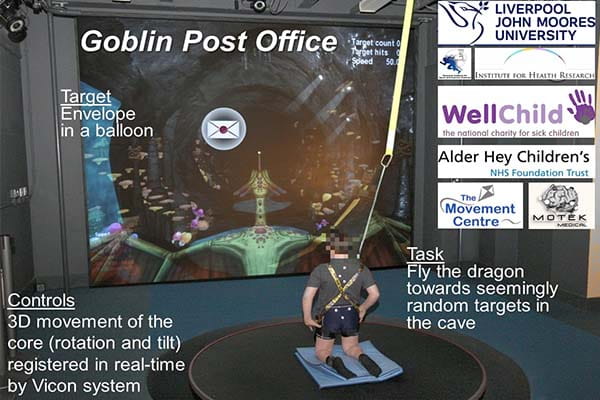
This area of work focuses on the rehabilitation of movement function in clinical populations such as cerebral palsy. Examples of ongoing research are the training and testing of core control using virtual reality games and the development and application of Virtual Mirror Box methods.
Training and testing core control using virtual reality games:
Our multi-disciplinary research team has developed custom made computer games focusing on movement co-ordination of the trunk and pelvis, known as the core of the body. In a recent pilot study, a group of children with cerebral palsy were recruited through Alder Hey Children’s Hospital, and over six weeks they played variants of the Goblin Post Office game on the first CAREN virtual reality system in the UK. In order to understand how their movement skills changed in response to the games training their walking style was tested using clinical gait analysis, and a detailed analysis was made of movement performance recorded while playing the games.
The findings of our research have been presented at national and international scientific conferences, and disseminated to physiotherapists in research seminars and postgraduate training programmes. We continue to analyse and publish the results of our research in peer reviewed scientific journals. The novelty and potentially high impact of our research has been recognised by the WellChild Researcher Award 2010.
The next stage of the research took place in schools across Merseyside. In order to make the method available to a larger number of children, a portable prototype of the game has been developed. It was used within a PhD study in schools to train and test children with cerebral palsy, focusing on the core of the body, as well as the ankle, knee, and hip joints. The portable Goblin Post Office is installed at The Movement Centre and BASIC where we are working towards integration of the game in the daily physiotherapy of patients with neuromuscular problems e.g. cerebral palsy.
We aim to improve hand function in scleroderma with our custom developed virtual rehabilitation game, FlappyBird-CAREN, which builds on the addictive power of Flappy Bird, the most downloaded smartphone game in 2013. Initially as a Masters student project and now as an LJMU PhD Scholarship programme we collaborate with Aintree Hospital NHS Foundation Trust.
We can now stream 3D hand movement data from the Leap Motion sensor into the D-Flow software (Motek) and this opens up the possibility of further smart games aiming at hand function rehabilitation.
Primary contact: Prof. Gabor Barton
Research assistant and then PhD student:
Richard Foster, 2009-2012. Funded by Alder Hey Children’s NHS Trust and LJMU’s Institute for Health Research.
Elena Eusterwiemann, 2016-2019. Funded by LJMU PhD Scholarship scheme.
Selected publications
Barton GJ, Hawken MB, Foster RJ, Holmes G, Butler PB, 2013. The effects of virtual reality game training on trunk to pelvis coupling in a child with cerebral palsy. Journal of Neuroengineering and Rehabilitation. 10:15. doi>
Barton GJ, Hawken MB, Holmes G, Schwartz MH, 2013. A gait index may underestimate changes of gait: a comparison of the Movement Deviation Profile and the Gait Deviation Index. Computer Methods in Biomechanics and Biomedical Engineering.
Virtual Mirror Box
A physical mirror positioned in the mid-sagittal plane can reduce phantom limb pain in amputees and improve movement function in stroke and upper limb control in children with cerebral palsy. A mirror illusion of unimpaired limb movement during gait might enhance the effect, but a physical mirror is only capable of showing parallel movement of limbs in real time while sitting, standing or lying. In this project, funded by LJMU’s Institute of Health Research, we aimed to overcome the limitations of physical mirrors by developing and evaluating a Virtual Mirror Box which delays the mirrored image of limbs during gait.
Most recently the Walton Centre NHS Foundation Trust has shown a lot of interest in the Virtual Mirror Box as one of many novel approaches relevant in neurology and neurosurgery. Collaboration efforts are underway to translate innovative research to clinical practice.
Primary contact: Prof. Gabor Barton
Selected publications
Barton JG, De Asha AR, van Loon ECP, Geijtenbeek T, Robinson MA, 2014. Manipulation of visual bio-feedback during gait with a time delayed adaptive Virtual Mirror Box. Journal of Neuroengineering and Rehabilitation. 11:101. doi>
Clinical gait analysis in alkaptonuria
We perform clinical gait analysis for all patients in the UK (and eventually the world) who were born with alkaptonuria and so develop early osteoarthritis.
Alkaptonuria is a rare metabolic disease leading to accumulation of homogentisic acid which damages cartilage, heart valves, kidneys, etc. The National Alkaptonuria Centre (NAC), based at the Royal Liverpool Hospital, is monitoring, treating and researching this medical condition. As part of the long term service provided to patients with alkaptonuria in collaboration with the Alkaptonuria Society, clinical gait analysis is performed for patients at LJMU funded by the NAC. We examine the natural progression of the disease with a focus on changes in movement function due to the special form of osteoarthritis which develops in patients with alkaptonuria. A clinical drug trial of nitisinone is currently under way and an advanced form of gait analysis is used to identify the optimal timing of treatment.
We have recently developed real-time gait training protocols using the M-Gait system and D-Flow software (Motek) to reduce joint loading and related pain. Patients modify their gait under continuous feedback about their knee joint moments, aiming to reduce loading by 10%.
Staff: Prof. Gabor Barton, Dr Mark Robinson
Research assistant: Kimberley Lewin, 2013-2014. Funded by the National Alkaptonuria Centre.
PhD student: Hannah Shepherd, 2017-2020. Match funded by the National Alkaptonuria Centre and LJMU.
Ranganath L, Khedr M, Milan AN, Davison A, Hughes A, Usher JL, Taylor S, Loftus N, Daroszewska A, West L, Jones A, Briggs M, Fisher M, McCormick M, Judd S, Vinjamuri S, Griffin R, Psarelli EE, Cox TF, Sireau N, Dillon JP, Devine JM, Hughes G, Harrold J, Barton GJ, Jarvis, JC, Gallagher JA (2018) Nitisinone arrests ochronosis and decreases rate of progression of Alkaptonuria: evaluation of the effect of nitisinone in the United Kingdom National Alkaptonuria Centre. Molecular Genetics and Metabolism. IF: 3.774
Griffin R, Psarelli EE, Cox TF, Khedr M, Milan AM, Davison AS, Hughes AT, Usher JL, Taylor S, Loftus N, Daroszewska A, West E, Jones A, Briggs M, Fisher M, McCormick M, Judd S, Vinjamuri S, Sireau N, Dillon JP, Devine JM, Hughes G, Harrold J, Barton GJ, Jarvis JC, Gallagher JA, Ranganath LR. (2018) Data on items of AKUSSI in Alkaptonuria collected over three years from the United Kingdom National Alkaptonuria Centre and the impact of nitisinone. Data in Brief. 20:1620-1628.
King SL, Barton GJ, Ranganath LR, 2017. Interpreting sources of variation in clinical gait analysis: a case study. Gait and Posture, 52: 1-4. doi>
Barton GJ, King SL, Robinson MA, Hawken MB, Ranganath LR, 2015. Age related deviation of gait from normality in alkaptonuria. Invited paper in Special Issue on Alkaptonuria, Journal of Inherited Metabolic Disease Reports. 24: 39-44. doi>
Artificial neural networks
A set of unique methods to quantify deviation of movement from normality to support clinical decision-making using artificial intelligence. Software tools developed in our project are available as free downloads.
Characteristics of abnormal gait can be captured by quantifying the three dimensional joint angles, moments and powers of the lower limbs but the complexity of the resultant high dimensional data space makes data interpretation prone to bias. Self-organising neural networks can be used to map complex gait data onto a two dimensional topographic map, thereby improving the efficiency of decision-making in clinical gait analysis.
We have developed the Movement Deviation Profile which shows the deviation of an individual’s movement from normality in a single curve and a single number.
Staff: Prof. Gabor Barton, Dr Malcolm Hawken, Dr Mark Robinson
Barton GJ, Hawken MB, Holmes G, Schwartz MH, 2013. A gait index may underestimate changes of gait: a comparison of the Movement Deviation Profile and the Gait Deviation Index. Computer Methods in Biomechanics and Biomedical Engineering. doi>
Barton GJ, Hawken MB, Scott M, Schwartz MH, 2010. Movement Deviation Profile: a measure of distance from normality using a self-organizing neural network. Invited paper in Special Issue on Network Approaches in Complex Environments, Human Movement Science. 31: 284-294. doi>
Barton GJ, Lees A, Lisboa P, Attfield S, 2007. Gait quality assessment using self-organising artificial neural networks. Gait and Posture. 25/3: 374-379. doi>
Barton JG, Lees A, Lisboa P, Attfield S, 2006. Visualisation of gait data with Kohonen self organising neural maps. Gait and Posture. 24/1: 46-53. doi>
One area of research has explored lower limb loading during human locomotion with reference both to sporting and clinical applications. Protective and therapeutic aspects of footwear have been a particular research focus and various commercial projects have been undertaken with footwear and sports surface manufacturers. Techniques have been developed to examine transient, high frequency aspects of lower limb loading and the possible links to specific overuse injury mechanisms. Recently, internal foot and lower leg loading has been estimated using finite element methods.
Primary contact: Dr Mark Lake
Selected publications
Müller, C., Sterzing, T., Milani, T. L., Lake, M. J., 2010. Different Stud Configurations Cause Movement Adaptations during a Soccer Turning. Footwear Science, 2: 1, 21-28.
Morio, C., Lake, M. J., Guequen, N., Rao, G., Baly, L., 2009. The influence of footwear on foot motion during walking and running. J. Biomechanics, 42, 2081-2088. doi>
Gu Y.D., Li J.S., Ren X.J. and Lake M., 2008. The mechanical response of Achilles tendon during different kinds of sports. Commun. Numer. Meth. Eng, 24: 2077–2085. doi>
Gu Y.D., Li J.S., Lake M., Ren X.J., 2008. Three dimensional finite element analysis of hind foot bones in jumping movements. Journal of Medical Biomechanics, 23(2): 127-130. doi>
Digby, C. J., Lake, M.J. and Lees, A., 2005. High-speed non-invasive measurement of tibial rotation during the impact phase of running. Ergonomics, 48,1623-1637.
Joint loading
In the joint loading group it is our aim to advance the understanding of lower limb joint loading in all types of locomotion through rigorous biomechanical investigation. Our research helps innovate and validate advanced biomechanical techniques, develop and disseminate good research practice in biomechanical investigation, and to ultimately support mechanistic study of lower limb injuries, disorders or diseases, such as ACL injury in sports or osteoarthritis in frail populations.
Our muscles and joints undergo stresses during the activities we do, whether that is walking to the shop, jogging around the park, or rapidly changing direction to avoid the defender during a game of football. These stresses can lead to slow adaptations of the structures around the bones or pose a threat of acute muscle or ligament injury. The research undertaken at LJMU focuses on both, specialising in accurate assessment of those stresses in all types of activity.
A particular area of interest is the application of advanced techniques to measuring joint loading and (in)stability around hip, knee and ankle. We have developed a cluster-based biomechanical model that allows us to investigate lower limb kinematics and kinetics and we continue to undertake extensive validations of this and other models. The use of functional joint axis definitions has been evaluated as well as the use of inverse kinematics solutions.
The in-depth knowledge gained with those advanced techniques is then used to interpret data acquired during standard clinical tests (e.g. single leg hop test) or field-based technologies (e.g. trunk mounted GPS systems). It has also allowed us to build advanced screening tests, which can help assess progress during rehabilitation process or provide a pre-season screening.
Primary contacts: Dr Jos Vanrenterghem and Dr Mark Robinson
Current PhD projects
Biomechanical and neuromuscular evaluation of knee muscle and ligament injury risk due to mechanical loading during dynamic sports (funded by Malaysian Government) - Raja Mohammed Firhad Bin Raja Azidin
Prevention of hamstring re-injury in professional football (funded by Liverpool FC) - Paulo Barreira
Pitch hardness: The relationship to perceived injury risk, injury prevalence and movement in elite football (funded by Leicester FC) - Dave Rennie
Identification of biomechanical risk factors for knee injury during dynamic activities (funded by Malaysian Government) - Raihana Binti Sharir
Neuromuscular screening for prediction of knee injury during dynamic tasks (funded by Malaysian Government) - Radin Rafeeuddin Bin Radin Dzulfakar
Player load monitoring in dynamic sports (funded by Football Exchange) - Niels Jensby Nedergaard
Selected publications
Selfe J, Janssen J, Callaghan M, Witvrouw E, Sutton C, Richards J, Stokes M, Martin D, Dixon J, Hogarth R, Baltzopoulos V, Ritchie E, Arden N, Dey P. 2016. Are there three main subgroups within the patellofemoral pain population? A detailed characterisation study of 127 patients to help develop targeted intervention (TIPPs). Br J Sports Med 50(14):873-80. doi>
Callaghan MJ, Guney H, Reeves ND, Bailey D, Doslikova K, Maganaris CN, Hodgson R, Felson DT. 2016. A knee brace alters patella position in patellofemoral osteoarthritis: a study using weight bearing magnetic resonance imaging. Osteoarthritis Cartilage 24(12):2055-2060. doi>
Meireles S, De Groote F, Reeves ND, Verschueren S, Maganaris C, Luyten F, Jonkers I. 2016. Knee contact forces are not altered in early knee osteoarthritis. Gait Posture 45:115-20. doi>
Robinson, M., Tsao, J., Donnely, C.J., Vanrenterghem, J. (In Press) The effect of choosing a direct kinematic or inverse kinematic model on ACL injury risk during side-cutting. Medicine and Science in Sport and Exercise.
Malfait, B, Sankey, S, Azidin, R, Deschamps, K, Vanrenterghem, J, Robinson, MA, Staes, FF, Verschueren, SMP, 2013. How reliable are lower limb kinematics and kinetics during drop vertical jump tasks?Medicine and Science in Sports and Exercise Science, epub. doi>
Verrelst, R, De Clercq, D, Vanrenterghem, J, Willems, T, Palmans, T, Witvrouw, E, 2013. A prospective study on full-body kinematic related risk factors in the development of exertional medial tibial pain. British Journal of Sports
Dingenen, B, Malfait, B, Verschueren, SMP, Staes, FF, Vanrenterghem, J., 2013. The reliability and validity of the measurement of lateral trunk motion in two-dimensional video analysis during unipodal functional screening tests in female athletes. Physical Therapy in Sport, epub. doi>
De Ridder, R, Willems, T, Vanrenterghem, J, Robinson, MA, Pataky, T, Roosen, P., 2013. Gait kinematics of subjects with chronic ankle instability using a multi-segmented foot model. Medicine and Science in Sports and Exercise, 2129-2136. http://doi>
Vanrenterghem, J., Venables, E., Pataky, T., Robinson, M. 2012. The effect of running speed on knee mechanical loading in females during side cutting. Journal of Biomechanics, 45, 2444-2449.
Robinson, M., Vanrenterghem, J. 2012. An evaluation of anatomical and functional knee axis definition in the context of side cutting. Journal of Biomechanics, 45, 1941-1946. doi>
Vanrenterghem, J., Gormley, D., Robinson, M., Lees, A. 2010. Solutions for representing the whole-body centre of mass in side cutting manoeuvres based on data that is typically available for lower limb kinematics. Gait and Posture, 31, 517-521. doi>
Postural stability
Maintaining postural stability and overall balance during everyday activities requires a complex control of intersegmental motion based on knowing the musculoskeletal capacity and interpreting various sources of sensory information. The main focus of our work is around the mechanistic aspects of how we are limited in balancing over the available contact points with the floor and the environment. This applies to the understanding of how and when someone is likely to fall, as well as to the understanding of how good balancing abilities can reduce the loading in the knee joint during dynamic sporting tasks.
The focus of our work is on the biomechanical constraints to which balance is tied. These constraints are universal and can be explored across the typical fields of interest. We have investigated this in the context of identifying the risk of falling through observing whether and how individuals can withstand perturbations to the body, and how this might be age dependent. We have looked at the role of whole-body balance during a catching task. We have identified how the musculoskeletal system is able to generate those internal forces that ultimately lead to the corrective movements.
Staff: Dr Jos Vanrenterghem
Current PhD projects
The role of dynamic stability in the movement execution of highly dynamic tasks (funded by Bolton University) - Sean Sankey
Selected publications
Sturnieks, D.L., Menant, J., Vanrenterghem, J., Fitzpatrick, R., Rogers, M. Lord, S.R., 2013. Predicting falls in older people from force-controlled balance perturbations. PLOS ONE, in press.
Tijtgat, P., Vanrenterghem, J., Bennett, S., De Clercq D., Savelsbergh, GJP, Lenoir, M., 2013. Postural adjustments in catching : on the interplay between segment stabilization and equilibrium control. Motor Control, Epub ahead of print.
Di Giulio I, Baltzopoulos V, Maganaris CN, Loram ID., 2013. Human standing: does the control strategy preprogram a rigid knee?J Appl Physiol 114,1717-29. doi>
Sturnieks, D.L., Menant, J., Vanrenterghem, J., Delbaere, K., Fitzpatrick, R., Lord, S. 2012. Sensorimotor and neurophysiological correlates of force thresholds for stepping in older adults.Gait and Posture, 36, 356-360. doi>
Tijtgat, P., Vanrenterghem, J., Bennett, S., De Clercq D., Savelsbergh, GJP, Lenoir, M., 2012. Implicit advance knowledge effects on the interplay between arm movements and postural adjustments in catching. Neuroscience Letters, 518, 117-121. doi>
Loram ID, Lakie M, Di Giulio I, Maganaris CN., 2009. The consequences of short-range stiffness and fluctuating muscle activity for proprioception of postural joint rotations: the relevance to human standing. J Neurophysiol 102(1):460-74. doi>
Di Giulio I, Maganaris CN, Baltzopoulos V, Loram ID., 2009. The proprioceptive and agonist roles of gastrocnemius, soleus and tibialis anterior muscles in maintaining human upright posture. J Physiol 587, 2399-416. doi>
Loram ID, Maganaris CN, Lakie M. 2009. Paradoxical muscle movement during postural control. Med Sci Sports Exerc 41,198-204. doi>
Advanced statistics in biomechanics
The development and dissemination of analysis tools ranging from basic data processing for undergraduate students to advanced vector field analysis based on statistical parametric mapping techniques.
Vector continuum schematic, depicting a mean two-muscle EMG waveform in blue along with inter-muscle dependence (EMG1-EMG2 covariance) and time-dependence (TIME-EMG smoothness).
Biomechanical data range from discrete 0D scalars to complex 3D vectors (and beyond). Traditional analyses of biomechanical data typically reduces the complexity of the dataset by extracting “key scalars” to analyse with standard statistical analysis techniques. The problem with this approach is that the selection of the “key scalars” is inherently biased unless a hypothesis directly pertained to that key scalar at that instance in time. Our research involves the analysis of n-D biomechanical data using statistical parametric mapping. We use traditional general linear models e.g. t-test, ANOVA, regression to analyse biomechanical data but with the maintenance of time within the analysis fundamentally differentiating it from traditional analyses.
Primary contact: Dr Mark Robinson
Selected publications
Pataky, T., Robinson M., Vanrenterghem, J., Savage, R., Bates, K., Crompton, R., 2014. Vector field statistics for objective center-of-pressure trajectory analysis, with evidence of scalar sensitivity to small coordinate system rotations. Gait and Posture 40(1):255-8. doi>
Pataky, T., Robinson, M., Vanrenterghem, J., 2013. Vector field statistical analysis of kinematic and force trajectories. Journal of Biomechanics, 46, 2394-2401. doi>
Pataky, T., Vanrenterghem, J. Robinson, M., Parametric and non-parametric confidence intervals and hypothesis tests regarding scalar trajectories. Submitted to Journal of Biomechanics.
De Ridder, R., Willems, T., Vanrenterghem, J., Robinson, M., Pataky, T., Roosen, P., 2013. Gait kinematics of subjects with chronic ankle instability using a multi-segmented foot model. Medicine and Science in Sports and Exercise, 45, 2129-2136. doi>
Vanrenterghem, J., Venables, E., Pataky, T., Robinson, M., 2012. The effect of running speed on knee mechanical loading in females during side cutting. Journal of Biomechanics, 45, 2444-2449. doi>
Collaborations
We have a history of working collaboratively with a number of national and international higher education institutions, and our research relationships include partnerships with: the University of Western Australia, Catholic University of Leuven, University of Gent, Manchester Metropolitan University, Brunel University, Bangor University, University of Bradford, University of Hull, University of Liverpool, Laval University (Canada), Shinshu University (Japan), Griffith University (Australia) and Brock University (Canada).
Distal-to-proximal progression of apophyseal injuries with age in male youth academy footballers: a two-season prospective cohort study of 16,024 player seasons
This study examined injury patterns in youth academy footballers across two seasons, revealing how apophyseal injuries progress from distal to proximal locations with age. The findings provide valuable insight into injury risk and player development.
Inverse dynamics, joint reaction forces and loading in the musculoskeletal system: guidelines for correct mechanical terms and recommendations for accurate reporting of results
Understanding musculoskeletal loading requires accurate terminology, methods and interpretation. This article provides guidance on reporting inverse dynamics, joint reaction forces and mechanical variables to improve clarity and consistency in biomechanics research.
The Effect of Exercise-Induced Muscle Damage on Lower Limb Side Cut Biomechanics and Task Achievement in Male and Female Team Sport Athletes
This study explored how exercise-induced muscle damage affects side-cutting biomechanics and task performance in male and female athletes. The findings highlight potential implications for injury risk assessment and performance monitoring.
Are there three main subgroups within the patellofemoral pain population? A detailed characterisation study of 127 patients to help develop targeted intervention (TIPPs)
Patellofemoral pain presents differently across individuals, making targeted treatment challenging. This study identified distinct patient characteristics to support more personalised assessment and intervention strategies.
A knee brace alters patella position in patellofemoral osteoarthritis: a study using weight bearing magnetic resonance imaging
This study investigated how a knee brace influences patellar position during weight-bearing activity in people with patellofemoral osteoarthritis, providing insight into potential mechanisms behind brace effectiveness.
Knee contact forces are not altered in early knee osteoarthritis
This study examined knee contact forces in individuals with early knee osteoarthritis and found that loading patterns may remain unchanged in the early stages of disease progression.
How Reliable Are Lower-Limb Kinematics and Kinetics during a Drop Vertical Jump?
Reliable movement analysis is essential for injury screening and research. This study evaluated the consistency of lower limb kinematic and kinetic measures during drop vertical jump tasks.
The reliability and validity of the measurement of lateral trunk motion in two-dimensional video analysis during unipodal functional screening tests in female athletes
This study evaluates the reliability and validity of measuring lateral trunk motion using 2D video analysis during single-leg screening tests in elite female athletes, highlighting its value for assessing movement quality and knee injury risk.
Gait kinematics of subjects with chronic ankle instability using a multi-segmented foot model
This study examines gait kinematics in individuals with chronic ankle instability using a multisegmented foot model, revealing detailed movement patterns missed by traditional rigid foot analysis.
The effect of running speed on knee mechanical loading in females during side cutting
This study explores how running speed influences knee loading during side cutting in female athletes, identifying a trade-off between performance and injury risk and supporting standardised testing speeds.
An evaluation of anatomical and functional knee axis definition in the context of side cutting
This study compares anatomical and functional knee axis definitions during side-cutting to improve consistency in biomechanical analysis and interpretation of knee kinematics and loading.
Solutions for representing the whole-body centre of mass in side cutting manoeuvres based on data that is typically available for lower limb kinematics
Explore how whole-body centre of mass is estimated during side cutting using lower limb kinematics and alternative motion capture approaches.
Ankle dorsiflexion range of motion is associated with kinematic but not kinetic variables related to bilateral drop-landing performance at various drop heights
Examine how ankle dorsiflexion range of motion relates to landing kinematics and kinetics during bilateral drop-landings across different drop heights.
What is the effect of ankle disk training and taping on proprioception deficit after lateral ankle sprains among active populations? – a systematic review
Explore the effects of ankle disk training and taping on proprioception after lateral ankle sprain in active individuals.